
Why Friendship Feels So Hard When You Have ADHD — And What to Do About It
Every week in the ADHD Families community, the same theme keeps surfacing.
Not mornings. Not meltdowns. Not school emails.
Loneliness.
Parents write that they wish they had people in their lives who actually got them. Who understood what their days looked like. Who didn't offer unhelpful advice or look at their child sideways at the park.
They want friends. And they feel quietly, persistently alone.
If that's you — this post is for you. Not for your child. For you.
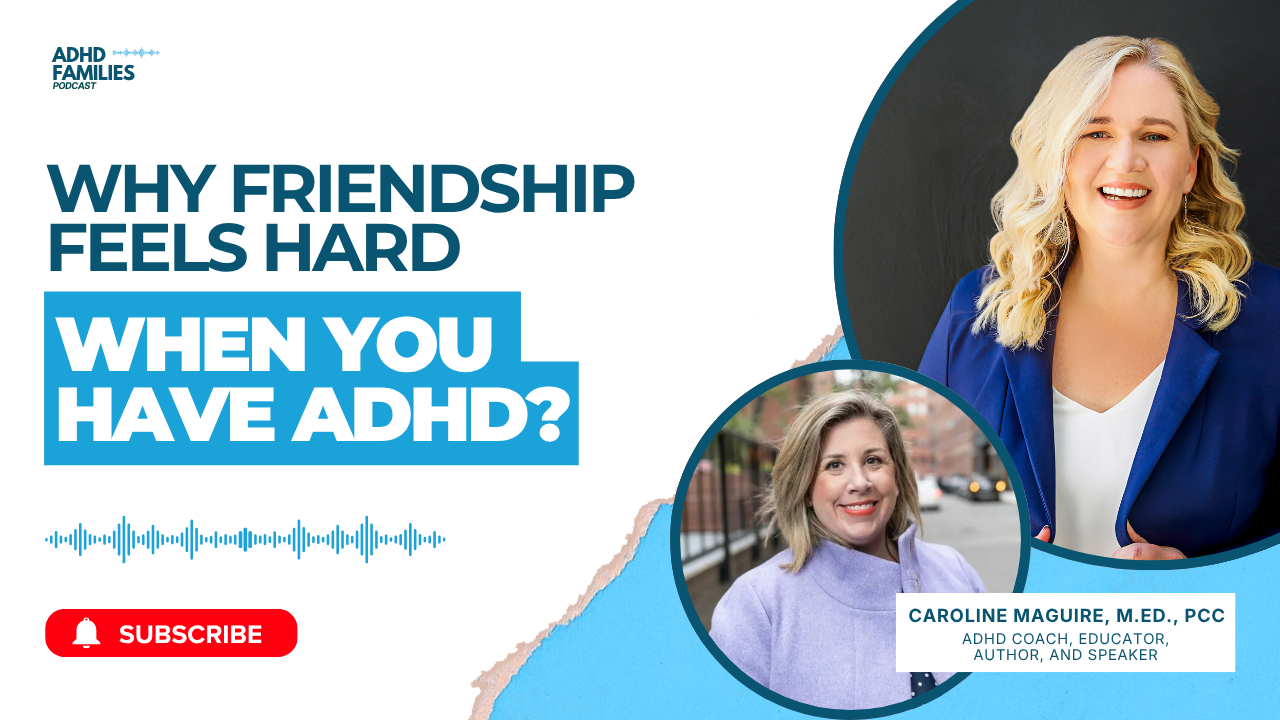
In Episode 78 of the ADHD Families Podcast, I sat down with Caroline Maguire — ADHD coach, social emotional learning expert, and author of Friendship Skills for Neurodivergent Adults — for one of the most honest conversations I've had on this topic. What follows is drawn from that episode, and I hope it changes how you see yourself.
Why Friendship Feels So Much Harder as an Adult
Here's the first thing Caroline wants you to know: you are not imagining it. Adult friendship is genuinely hard. Not just for ADHD adults — for everyone.
There is a worldwide loneliness epidemic. Princess Catherine has spoken about it. Research confirms it. Millions of people — neurotypical and neurodivergent alike — are buying friendship books and sitting in the exact same loneliness you are.
But for adults with ADHD, there is an additional layer.
In childhood, friendship happened almost by accident. You were placed in classrooms with the same people every day. You had group projects, sports teams, shared lunches. There was a natural scaffolding that moved you toward connection without you having to engineer it.
In adulthood, that scaffolding disappears.
And for parents of children with ADHD, it disappears even faster. Many parents make friends through their children — through sport, school pickup, playdates. But when your child leaves the playground early, or struggles socially, or finds organised sport overwhelming — those pathways close. You're chasing your child at every playdate. You get two words into a conversation before someone needs you. Two words does not build a relationship.
We see the world differently. We think differently. We friend differently. And that's okay. Now let's figure this out.
— Caroline Maguire
Friendship Is a Learnable Skill — Not a Personality Trait
This is the reframe that Caroline says stops people in their tracks.
Most of us believe we are simply good or bad at friendship. That some people are naturally warm and socially gifted, and others — us — are just not wired that way.
The research says otherwise.
Emerging evidence over the past five years shows that friendship is not primarily about having perfect social skills. It is about learnable skills — proximity, participation, communication, repair — that can be built at any age.
No one taught us these skills. Not in a way that worked for how our brains actually work. The books that exist were written by neurotypical people, for neurotypical people. Caroline's book is the first of its kind — written by a neurodivergent person, for a neurodivergent audience.
That matters. Because trying to use a map that was drawn for someone else's brain has never worked for us — and it never will.
The Single Biggest Factor in Making Friends
Proximity.
Not personality. Not social confidence. Not having the perfect thing to say.
Proximity — showing up to the same place consistently, interacting with the same people repeatedly — is the most powerful friendship-building force there is. Caroline's decade of research kept coming back to this.
The challenge for ADHD adults is that we opt out of proximity more than most. We are behind on work. Behind on housework. Overwhelmed. So we skip Thursday. And the week after. And proximity evaporates.
The solution is not willpower. It is systems. Executive function strategies that make showing up easier — that Caroline walks through in her book — can make proximity possible even on hard weeks.
And proximity does not have to be in person. Online counts. Community counts. Showing up in the same spaces — physically or digitally — is where friendship begins.
The Hidden Cost of Masking
Many ADHD adults have become skilled at appearing socially confident. Agreeing to things that feel overwhelming. Going along with plans that are sensory nightmares. Managing how loud they laugh, what they say, what they don't say.
This is masking. And it has a cost that most people don't talk about.
Burnout. Depression. Anxiety. And something quieter but just as damaging: an entire social life built around people you don't actually feel belonging with.
When you mask your way into friendships, you are not building real connection. You are building a performance. And you cannot sustain it — which is often why relationships that looked fine from the outside suddenly collapse.
The more you can unmask — slowly, safely, in increments — the less energy socialising costs. That's not just advice. It is neurological reality. Managing your authentic self requires far less energy than performing a version of yourself that doesn't exist.
Why You Feel Wiped Out After Socialising — Even When It Goes Well
If you regularly come home from social events feeling like you need three days to recover, you are not dramatic. You are experiencing a real phenomenon.
For ADHD adults, socialising involves a significant cognitive load. Managing attention. Managing executive function. Getting to the venue — which alone can be exhausting. And then managing the social performance itself.
Caroline's advice is not to socialise less. It is to socialise more intentionally.
Before saying yes to something, ask: is this high value? Does it move me toward genuine connection, or does it drain energy for connection that isn't really there?
And build in the pause. Future you always seems more capable than present you. The pause — taking a moment before responding to invitations — is not avoidance. It is self-knowledge.
The Flavours of Friendship
One of the most practically useful frameworks in this episode is what Caroline calls the Flavours of Friendship.
Most adults — particularly ADHD adults — collapse all friendship into one category. Someone is either a friend or they're not. This leads to enormous disappointment, hurt feelings, and lopsided relationships where we give far more than we receive.
In reality, friendship has levels:
- Familiar faces — people you recognise but don't know
- Acquaintances — people you know, but without a history of trust
- Emerging friends — people you are becoming friends with, actively
- Friends — people who give and receive, who treat you well
- Close friends — two or three people in a lifetime who know everything
The key insight for ADHD adults is this: we frequently treat acquaintances as close friends. We share deeply, give generously, and expect reciprocity that the relationship has not yet earned. When it doesn't come, we take it personally — and add it to the evidence that we are bad at friendship.
We are not bad at friendship. We are rushing the levels.
Trust is built through track records. Close friendship takes time — roughly 70 hours of repeated interaction, growing a little with each one. That is not a flaw in the system. That is how it works for everyone.
Info Dumping, Oversharing, Going Quiet — Shame vs Skill Building
These are the patterns ADHD adults are most ashamed of in social settings. Caroline reframes all three.
Info dumping
This is not a mistake. It is a neurodivergent communication style. The skill is not to eliminate it, but to frame it — to signal you're about to share something, to check in for reciprocity, to make sure you're part of a conversation rather than delivering a monologue. It can be a piece of how you connect. It cannot be the only piece.
Oversharing
It will probably always happen to some degree. The goal is not to never overshare again — that expectation will crush your confidence. The goal is to build awareness, to curtail it when you want to, and to be kind to yourself when it happens anyway.
Going quiet
Caroline calls this the most damaging pattern of all. Not because shutting down is wrong — but because disappearing without explanation leaves people in the dark. They don't know if they've done something wrong. They don't know if you're okay. And if it continues, they stop reaching out.
The repair for going quiet is simpler than most people think. A brief message: I dropped off, here's what was going on, I missed you. Own your part without grovelling. Tell the person you want them back if you do. Then keep the contact going — even a small joke, a photo, a one-liner. Systems help: Caroline responds to messages every time she waits for her son's bus. Anchored habits create consistency where willpower cannot.
It Is Never Too Late
This is what Caroline wants every lonely adult reading this to hear.
Maybe your parents didn't teach you these skills. Maybe it never came intuitively. Maybe you feel like you are so far behind that there is no point starting.
None of that is true.
There is a path forward. It takes time. It requires learning things that should have been taught earlier. But it is available — and it can be genuinely joyful.
When you have a medical test or a family member falls ill, you want someone to reach out. You want to know someone is thinking of you. That is not a small thing. That is the whole thing.
You deserve that. And it is possible to build it — at any age, from wherever you are starting.
Resources & Links
🎧 Listen to Episode 78: Why Friendship Feels Hard When You Have ADHD
📚 Friendship Skills for Neurodivergent Adults by Caroline Maguire — available at Amazon, Audible, and wherever books are sold
- 🌐 carolinemaguireauthor.com
- 📱 Instagram: @authorcarolinecm
- 👍 Facebook: Caroline Maguire, M.Ed, ACCG, PCC
- 🎙️ Her new podcast: Your ADHD Social Playbook
- 🎥 TEDx Talk — search Caroline Maguire on YouTube
- thefunctionalfamily.com — more support for ADHD families
About Sharon Collon
Sharon Collon is a PCC credentialed ADHD family coach and founder of The Functional Family. She works with parents of children with ADHD who are exhausted by the daily battles — and helps them build a family life that actually works.
Her approach is practical, ADHD-informed, and built around real family systems — not generic parenting advice that wasn't designed for your child's brain.
👉 Learn more at thefunctionalfamily.com
Join our free ADHD support group
Your tribe is here waiting for you. Join us now.
Want support? Join our Free Community for families navigating ADHD

Book a FREE 15 min discovery call with Sharon
Sharon is an award winning credentialed ADHD coach and parenting consultant who is specifically trained to work with families navigating ADHD. She is passionate about creating ADHD-friendly systems to make family life easier with ADHD. Find out how she can help you and/or your family.
🎥 Loved this post?
Catch the full conversation on YouTube!
We dive deeper into this topic in the latest podcast episode—real talk, practical tips, and plenty of “oh wow” moments.
Don’t forget to like & subscribe!
