
Managing Sibling Conflict & ADHD with Jacquie Ward
It's Sunday afternoon. Your kids can't walk past each other without one of them baiting, touching, or starting something. Every single interaction becomes a battle. And somewhere in the middle of it, you find yourself wondering — when these two grow up, are they ever going to be friends?
If that scene is familiar, this post is for you.
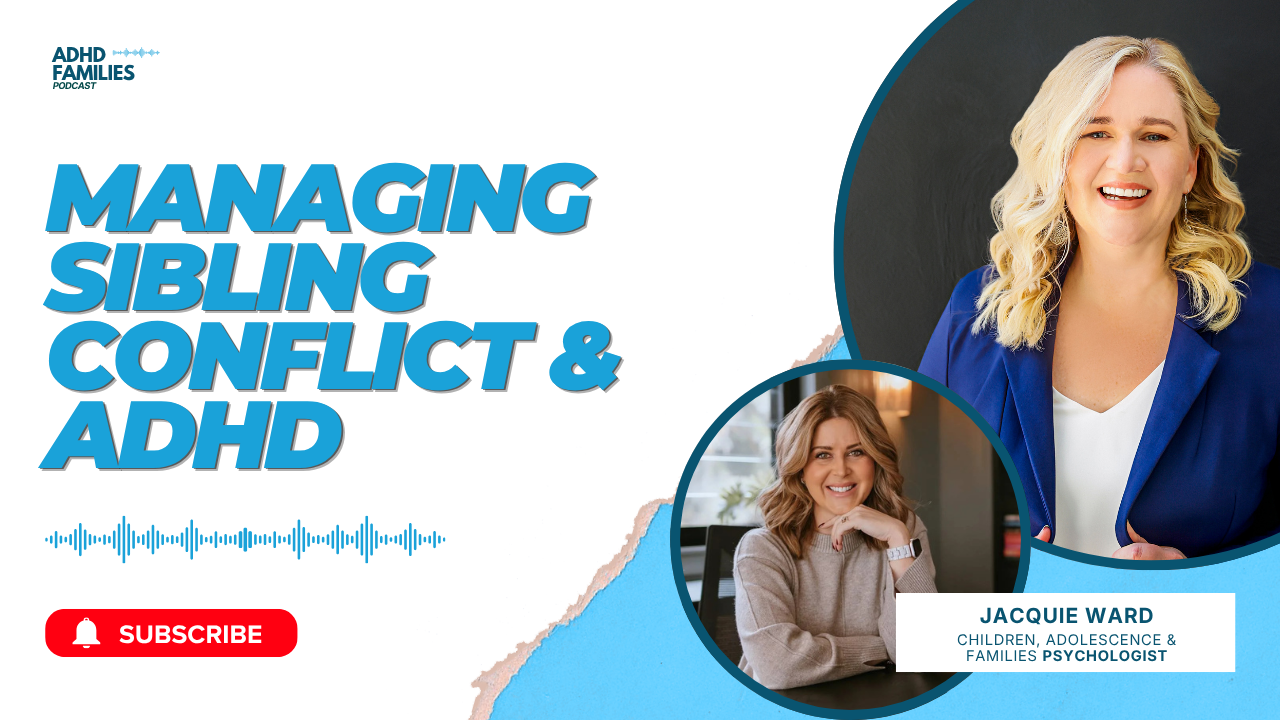
In Episode 79 of the ADHD Families Podcast, I sat down with Jacquie Ward — Registered Psychologist and mum of three, including a child with ADHD — to have the most direct, practical, useful conversation about sibling conflict I have ever had.
Sibling conflict is the number one issue parents bring to my family coaching sessions. It sits at the top of Jacquie's psychology caseload too. And if you are navigating ADHD in your home, the research is clear: the conflict is more intense, more frequent, and harder to recover from than it is in most neurotypical families.
That is not a failure. It is a very predictable outcome of some very specific factors. And once you understand them, everything changes.
Why It Is Harder in Your Home
Parents in ADHD families often carry a quiet layer of shame underneath the chaos. They wonder what it means that their children cannot be in the same room. They worry about what it says about them as parents, and what it means for the future of their children's relationship.
Here is what Jacquie and I want you to hear first: you are not imagining it. And you are not the cause of it.
ADHD adds very specific ingredients that amplify every standard sibling dynamic. When one child has ADHD, these factors show up daily. When two or more children have ADHD, you are layering storms on top of each other.
This isn't personality. It's neurology doing what it does.
The Six ADHD Factors That Create the Perfect Storm
- Emotional dysregulation
Emotions are felt intensely in ADHD brains. What would be a small annoyance for a neurotypical child — a poke, a look, a bump in the hallway — can feel enormous and provoke a reaction that looks wildly disproportionate from the outside. The child is not being dramatic. The emotional experience is genuinely that big.
- Impulse control
There is no gap between thought and reaction. Something irritating happens, and the ADHD brain responds before any reasoning can intervene. This is why things escalate so quickly and why asking a child in the middle of conflict to "just stop" is setting everyone up for failure.
- Black and white thinking
The rigidity of right and wrong that shows up in so many ADHD children makes navigating the grey areas of sibling relationships genuinely hard. Whether something was meant as a joke or as a slight, whether something was fair or unfair — these nuances are difficult to process, and they send a lot of parents straight into referee mode.
- Low frustration tolerance
When losing is extremely difficult, and met with explosivity or shutdown, it makes playing together, competing, or simply sharing space very hard to sustain. Activities that should be fun become minefields.
- Difficulty reading social cues
ADHD children often miss the signals that tell them a sibling has had enough, that the banter has tipped from fun into hurtful, or that someone needs a break. What feels like playful teasing from one child lands as something much more painful for the other.
- Rejection and justice sensitivity
When something feels unfair — even if it was unintentional — the reaction is intense and difficult to talk down. Justice sensitivity is one of the most underappreciated ADHD traits, and it drives more sibling conflict than most parents realise.
Executive Function Age vs Chronological Age
One of the most important reframes in this episode is the concept of executive function age versus chronological age.
A child with ADHD is a minimum 30% behind their peers in executive function development. A 10-year-old with ADHD is regulating and problem-solving more like a 7-year-old. When we hold our children to the standard of their chronological age — or worse, compare them to neurotypical siblings or cousins — we are setting up expectations that their brain development simply cannot meet yet.
This does not mean lowering the bar forever. It means meeting your child where they actually are, building skills from that baseline, and giving yourself permission to stop measuring them against a standard that was never designed for their brain.
I need to get this tattooed on my hand — because I'm looking at my 17-year-old and expecting them to be a 17-year-old.
— Sharon Collon
The Family Nervous System
One of the things Jacquie and I talk about a lot is the concept of the family nervous system — the idea that emotional contagion is real, and when one person in the family dysregulates, it ripples through everyone else.
This is why the whole house feels it when one child melts down. It is why conflict at home escalates so fast. And it is why conflict in public, when you feel watched and judged, can feel so much more intense than the same conflict at home.
You are not overreacting to the conflict. Your nervous system is responding to something genuine. Understanding this removes a layer of self-blame and makes space for a more strategic response.
Why Prevention Beats Reaction Every Time
The instinct when sibling conflict is relentless is to manage it in the moment — to referee, to intervene, to find the right thing to say when emotions are running hot.
But the real work happens in all the other moments. Ten minutes of intentional investment in connection, skills, and proactive strategy prevents the equivalent of a full crisis. Reactive mode is exhausting precisely because it never addresses what is actually driving the conflict. Prevention is not passive. It is the most strategic thing you can do.
And this applies to your own regulation too. When we are dysregulated as parents — which is completely understandable in an ADHD household — we add heat to an already hot situation. Understanding your own triggers and having a strategy ready for yourself is as important as having one for your children.
The Three Cs Framework: Cool Down, Communicate, Collaborate
This is the framework Jacquie and I use across the workshop series. It gives parents a clear, repeatable process that works both in the moment and as a long-term skill-building approach.
Cool Down
You cannot problem-solve when dysregulated. Neither can your child. The most important first move — before any words, before any consequences, before any resolution — is to take the beat. This is not avoidance. It is the single most effective thing you can do in the heat of conflict. The nervous system needs to come down before the brain can reason.
What does cool down look like? It is different for every family. It might be physical distance, a sensory strategy, a non-verbal signal that everyone recognises. The key is that it is agreed on before the conflict, not invented in the middle of it.
Communicate
Once everyone is calmer — not calm, calmer — you open the floor. Each child gets to name what happened, what they felt, and what they needed. This sounds simple. It is not easy. But it is the skill that creates the most change over time.
ADHD children are often reacting to an emotional experience they do not have the language to name. When we give them that language — when we model it and build it consistently — we are teaching them something that will serve them far beyond sibling conflict.
Collaborate
This is the long game. Instead of imposing referee-style solutions, the Collaborate phase builds the skills for children to problem-solve together over time. It moves the parent out of the referee seat and into the coach seat — and it is what reduces reliance on you as the mediator.
Collaboration does not mean children resolve everything themselves overnight. It means building toward that capacity incrementally, through repeated practice, with adult scaffolding that gradually steps back.
The Referee Trap
One of the most important things Jacquie and I discuss in this episode is why jumping in as referee — deciding who started it, who was wrong, who owes whom an apology — tends to make things worse rather than better.
When we step in as referee, we activate the ADHD child's rejection and justice sensitivity in the worst possible way. We become part of the conflict. We add heat. And we take away the opportunity for children to build the skills they actually need.
The Three Cs framework is designed precisely to take you out of the referee role. Not because you step back from the conflict, but because you step into it differently — as a coach rather than a judge.
The One Thing to Do This Week
If you take nothing else from this post, take this.
Before the next sibling conflict happens — and it will — decide what your Cool Down strategy is. Make it simple. Make it visual if that helps. And tell your children what it is before they need it.
You are not stuffing this up. Your family is not beyond support. Sibling conflict in ADHD homes is one of the most predictable, most common friction points we navigate. It is not beyond help. It just needs a framework, a little intentional energy, and some strategies that were actually designed for how your family works.
All it is is a friction point that needs our attention for a little bit — and a little bit of strategy — to make this easier for you.
— Sharon Collon
Resources & Links
- Listen to Episode 79 of the ADHD Families Podcast
- Jacquie Ward— Registered Psychologist
- Sibling Conflict & ADHD Workshop Series (May 11–13)
- More support for ADHD families
About Sharon Collon
Sharon Collon is a PCC credentialed ADHD family coach and founder of The Functional Family. She works with parents of children with ADHD who are exhausted by the daily battles and helps them build a family life that actually works.
Her approach is practical, ADHD-informed, and built around real family systems — not generic advice that wasn't designed for your child's brain.
👉 Learn more at thefunctionalfamily.com
Join our free ADHD support group
Your tribe is here waiting for you. Join us now.
Want support? Join our Free Community for families navigating ADHD
Recent Posts

Book a FREE 15 min discovery call with Sharon
Sharon is an award winning credentialed ADHD coach and parenting consultant who is specifically trained to work with families navigating ADHD. She is passionate about creating ADHD-friendly systems to make family life easier with ADHD. Find out how she can help you and/or your family.
🎥 Loved this post?
Catch the full conversation on YouTube!
We dive deeper into this topic in the latest podcast episode—real talk, practical tips, and plenty of “oh wow” moments.
Don’t forget to like & subscribe!
