
School Camp and ADHD: How to Prepare Your Child (and Survive the Comedown After)
The note comes home in the school bag. School camp, three nights, sign here.
Everyone else's parents just sign the form. You're standing in the kitchen running the whole thing in your head. The unfamiliar place. No routine. The sleep. The medication. Three days of being switched on from morning to night with nowhere to hide and no break.
And underneath all of it, the real question. Will they cope, and can I actually send them?
If that's you, you're not being dramatic and your child isn't fragile. Camp is genuinely hard for an ADHD brain, and it's hard for reasons you can predict. That's the good news buried in here. Anything you can predict, you can prepare for. Camp is not a test of whether your child can cope without support. It's a chance to show them they can cope when the right support travels with them.
I'm Sharon Collon, a PCC Credentialed ADHD Coach and Parenting Consultant. I'm also a mum of three boys with ADHD, so I've signed the camp form with my stomach in knots more than once. I've worked with over 40,000 families across Australia, and "my child has camp coming up and I'm panicking" is one of the most common messages I get. Here's how to walk the whole thing, start to finish.
Why is school camp so hard for children with ADHD?
Because camp quietly removes every support your child leans on, all at once.
Think about what holds a child with ADHD together on an ordinary day. A familiar environment. A predictable routine that does a lot of their thinking for them. Their own bed, their own food, their own quiet corner. And a safe person nearby when it all gets too much.
Camp takes every one of those away in a single go. The place is new. The routine is gone. Sleep gets shorter and lighter, right when they need it most. The social demand is relentless, all day and into the night, with no downtime built in. And you, the safest person in their world, aren't there.
That's an enormous amount of scaffolding to pull away at once. So of course it's hard. It would be hard for plenty of adults. The job isn't to pretend camp is easy. It's to put some of that scaffolding back, deliberately, in a form your child can carry with them.
Should my child with ADHD even go to camp?
Often yes, and here's the part most parents don't realise: it doesn't have to be all or nothing.
Camp is not a single fixed thing you either do or don't do. For some children, three nights is right. For others, the first camp might be one night, a day visit, or being collected after the evening activity and sleeping in their own bed. Talk to the school about what's possible. Partial camp is still camp.
A shorter first experience that goes well beats a full experience that overwhelms them and teaches them they can't do it. You're building a track record of "I can do hard things", one manageable step at a time. That track record is worth far more than three nights ticked off for the sake of it.
How do I prepare my child with ADHD for school camp?
Most of the work happens before they ever get on the bus. Preparation is where you rebuild the scaffolding.
Brief the camp early. Don't assume the classroom teacher has passed anything on, and don't assume the camp staff know your child. Ask for a short conversation or send a one-page note. Keep it practical, not a diagnosis dump. What helps your child. What their warning signs look like before they tip over. What calms them, and what makes things worse. Who they can go to if they're struggling, and the words that actually work. You're handing the staff the manual so they're not learning your child from scratch at ten at night in an unfamiliar cabin.
Protect sleep, and rehearse the unfamiliar. Sleep is usually the first domino to fall. In the week or two before camp, guard their sleep like it's gold. Then do a practice run of anything new about sleeping there. A brand-new sleeping bag is a bad surprise on night one, so use it in the lounge room first. Same with a torch, an alarm, or earplugs if a noisy cabin is likely. Familiar beats new every time for an ADHD brain under stress.
Build a packing system, not a pile. Don't pack for them and wave them off, and don't just hand them a list and hope. Label everything, because ADHD and lost property are old friends. Pack in daily outfits rather than piles, so there's no decision to make each morning. A ziplock bag per day is a classic for a reason. Tape a visual checklist inside the bag lid so they can see what should be there. You're designing it so the organised thing is the easy thing, even without you standing over them.
Pack connection. Tuck in something that feels like home. A note in each day's bag. A small familiar comfort item, even if they're supposedly too old for it, hidden somewhere private and agreed on beforehand so they're not embarrassed. These little anchors are what they reach for in the wobbly moments, and the wobbly moments are usually at bedtime.
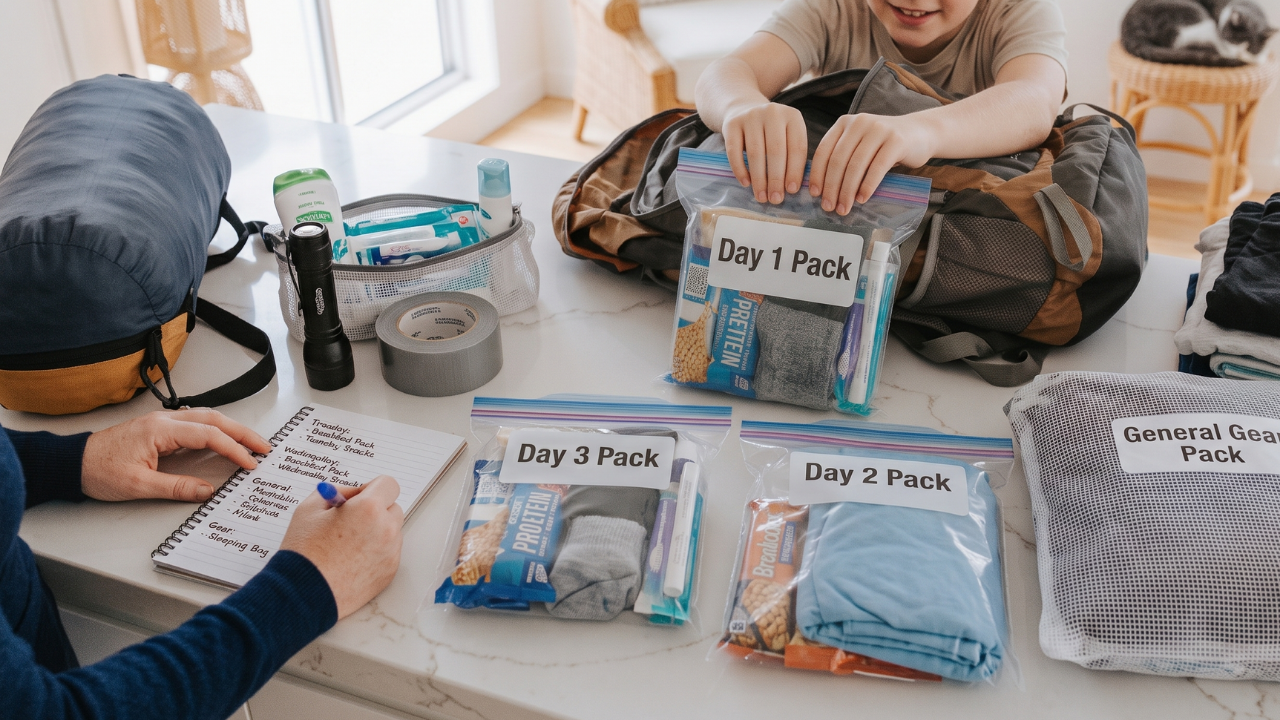
A camp bag packed in labelled daily ziplock bags with a visual checklist for a child with ADHD
What about medication at camp?
This one is a conversation to have with your prescriber, well before camp, not a decision to make on the morning.
Camp days are longer and more physically demanding than school days. The medication timing that suits an ordinary Tuesday may not fit a full day of hiking, activities and a late night. Your prescriber is the right person to talk through timing, and the school is the right place to sort out who holds and administers medication at camp, and how. Get that agreed in writing rather than leaving it to chance.
None of this is a reason to keep your child home. It's simply a logistics conversation worth having early, so it's one less thing wobbling in the background while they're away.
Here's a question worth sitting with: if you already know the moments at camp most likely to overwhelm your child, what could you put in place before they go, instead of hoping it works out on the night?
How do I help my child cope while they're there?
You can shape a surprising amount of this in advance, even though you won't be in the room.
Give them a point person. The single most useful thing you can set up is one named adult your child knows they can go to. Not "the teachers." A name. "If you're struggling, you find Miss Davies." An overwhelmed child with ADHD cannot scan a room and work out who's safe, so pre-decide it, and tell the point person too, so they're expecting it.
Send a regulation plan they can run themselves. Talk through, before camp, what they'll do when it gets to be too much. Where they can go. What they can do with their body to settle. And normalise stepping out: "It's completely okay to take yourself somewhere quiet for a few minutes. That's not you failing camp, that's you being smart." You're giving them a script to steady themselves, since your calm won't be there to borrow.
Lower the social bar out loud. A lot of camp meltdowns are simply social exhaustion. So tell them the truth in advance. You don't have to be "on" the whole time. You don't need a best friend by day two. It's fine to be quiet, and it's fine to need a break from the other kids. Permission given ahead of time takes the pressure off a system that's already stretched.
Manage yourself while they're away. At most camps, no news is good news. Schools usually only call if there's a real problem, so the silence is your child coping, not your child in crisis. The not-knowing is hard, but your job while they're gone is to trust the scaffolding you built and let them use it.
Why does my child fall apart after camp?
Because they held it together for three days straight, and the moment they're safe again, it all has to come out.
This is one of the most confusing parts of camp for parents. Your child copes beautifully while they're away, then gets in the car or walks through the door and completely falls apart. Sobbing, raging, or shut down and monosyllabic. And you think, but I thought camp went well?
It probably did. What you're seeing is after-camp restraint collapse. It's the same release you might have seen after a big school day, just on a three-day scale. They've been switched on, away from their safe person, running on broken sleep, for days. The bill comes due the second they're back in the one place safe enough to let go, which is home, with you.
So handle the pickup gently. Don't debrief in the car. Hold back the twenty questions about who they slept near and whether they ate and whether so-and-so was kind. A brain running on empty and three nights of poor sleep cannot narrate its camp experience to you on the drive home. The story comes out later, in pieces, usually sideways when you least expect it.
Then plan for recovery the way you'd plan for any predictable friction point. Clear the calendar for the day after camp if you possibly can. Expect a lower-capacity, shorter-fused child for a couple of days and drop your demands to match. Extra sleep. Familiar food. Low stimulation. Their own bed and their own quiet corner, all the things they just went days without. You're refilling a tank that's run completely dry, and that takes a few days. Don't schedule anything big into it.
When to get more support
If camp is one flashpoint among many, and daily life with your child already feels like bracing for the next hard moment, it's worth building a proper plan with someone who understands ADHD. Not because anything is wrong with your child, and not because you've missed something. A family carrying this level of daily load deserves a real system, not another list of tips.
Camp is a big, obvious example of something true about every hard moment in your week. It feels like chaos you have to survive, when it's actually a friction point you can plan for. The unfamiliar environment, the sleep, the social load, the medication timing, the comedown at the end. Every one of them is knowable before your child goes. And knowable means plannable.
That's exactly what I walk families through in my free online masterclass, The ADHD Family System. Together we map your family's friction points onto a Friction Map, then build the system version for the ones costing you the most. Once you can do this for camp, you can do it for the mornings, the afternoons, the transitions, all of it.
The masterclass is free and runs live three times so you can pick a session that suits:
Session Option 1: 1 September at 7PM
Session Option 2: 4 September at 1PM
Session Option 3: 8 September at 7PM
Register for the free ADHD Family System masterclass →
Join our free ADHD support group
Your tribe is here waiting for you. Join us now.
Want support? Join our Free Community for families navigating ADHD

Book a FREE 15 min discovery call with Sharon
Sharon is an award winning credentialed ADHD coach and parenting consultant who is specifically trained to work with families navigating ADHD. She is passionate about creating ADHD-friendly systems to make family life easier with ADHD. Find out how she can help you and/or your family.
🎥 Loved this post?
Catch the full conversation on YouTube!
We dive deeper into this topic in the latest podcast episode—real talk, practical tips, and plenty of “oh wow” moments.
Don’t forget to like & subscribe!
