
Why Reward Charts Stop Working for Children With ADHD (and What to Do Instead)
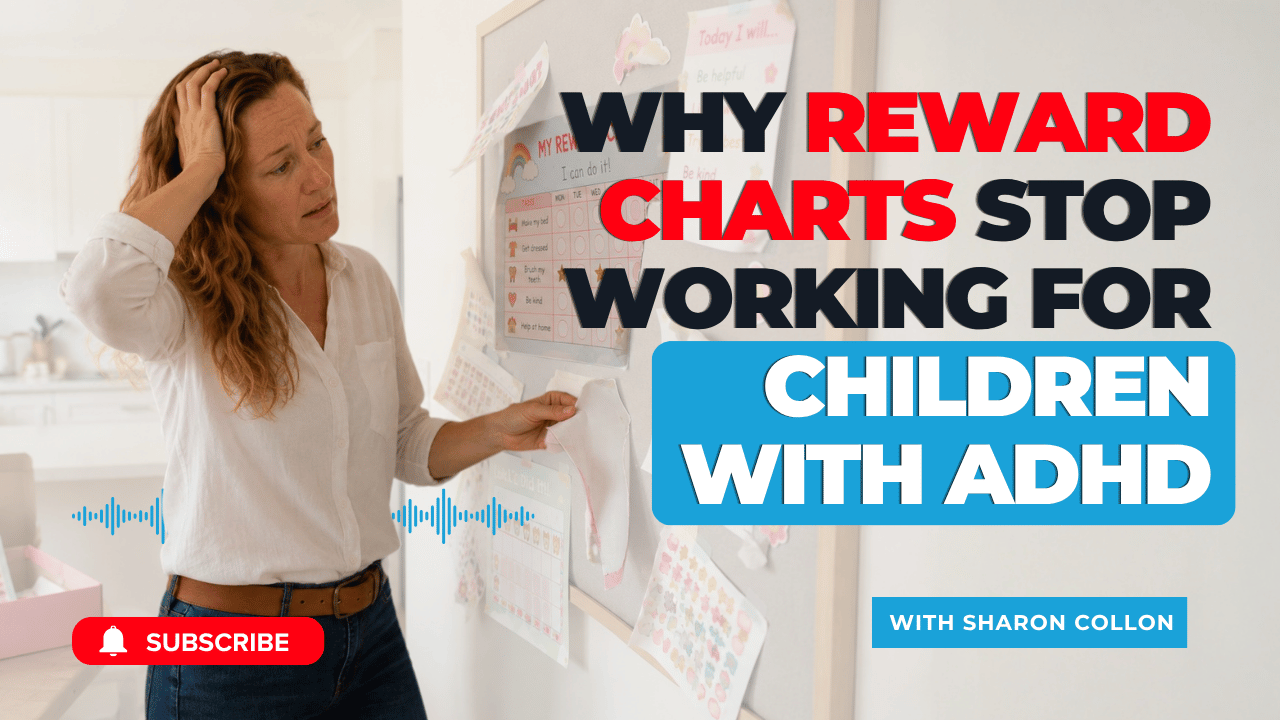
Week one, the sticker chart is magic.
Your child is racing to the fridge, gold stars everywhere, doing the very thing that's been a battle for months. You think, finally, this is the one. Week two, nobody can find the chart. By week three you're the only person who remembers it exists, quietly awarding stars to a piece of paper no one looks at.
If your kitchen drawer is a graveyard of abandoned reward systems, sticker charts, token jars, pocket-money apps, laminated wall planners, you are not inconsistent and your child is not lazy. Reward charts stop working for children with ADHD for reasons built right into how the ADHD brain runs. Once you understand those reasons, the fix becomes obvious, and it's not a better chart.
I'm Sharon Collon, a PCC Credentialed ADHD Coach and Parenting Consultant, and a mum of three boys with ADHD. I have bought every reward chart on the market. I've worked with over 40,000 families across Australia, and "why don't reward charts work" is a question I hear constantly. Here's what's really going on.
Why don't reward charts work for children with ADHD?
Because a reward chart bets everything on long term novelty and delayed payoff, and the ADHD brain is wired against both.
Here's the mechanism. When the chart is new, it's interesting, and novelty gives the ADHD brain a hit of dopamine, the brain chemical that drives motivation. That's the week-one magic. But novelty fades fast, dopamine moves on to the next new thing, and the moment the chart stops being interesting, it stops working. The chart didn't fail because your child gave up. It failed because it was running on a fuel that always runs out.
The second problem is timing. Most charts pay out later: five stars by Friday and you get the reward. A neurotypical brain can hold a goal like that across a week. An interest-based ADHD brain struggles to feel a reward that isn't happening right now. As the saying goes, the ADHD brain pays in cash, not credit. A prize on Friday has almost no pull on a Tuesday.
So you end up with a tool that's motivating for about a week and then becomes one more thing on your list to manage.
Is my child just not trying hard enough?
No. And neither are you.
This is the trap reward charts quietly set. When the chart stops working, it looks like a willpower problem, your child's or yours. So everyone tries harder. You add bigger rewards, sterner consequences, more elaborate charts. None of it holds, because the problem was never effort. The problem is that you were asking a brain with a motivation and timing difference to run on a system designed for a brain that doesn't have one.
A child with ADHD can genuinely want to do the thing, know how to do the thing, and still not do the thing, because the gap between intention and action is exactly where ADHD lives. No sticker closes that gap for long.
Letting go of the willpower story is the first real shift. Your child isn't choosing not to try. The tool was working against their wiring.
Here's a question worth sitting with: how many of the routines that actually run smoothly in your house rely on a reward, and how many just happen because the setup makes them easy?
What works better than sticker charts for ADHD?
Systems. A system removes the decision instead of rewarding it.
A reward asks your child to choose the hard thing and then pays them for choosing it. A system changes the environment so the hard thing becomes the easy, obvious next step, and barely needs a decision at all. Rewards lean on motivation, which for an ADHD brain is unreliable by design. Systems lean on the setup, which stays put.
Here's the difference in real life.
The reward version: a star every time your child puts their school bag away. Works for a week, fades, becomes your job to track.
The system version: a hook at your child's height, right beside the door they walk in, with nothing else competing for that spot. The bag goes there because that's the easiest place for it to go. No star. No tracking. No daily admin for you.

A simple front-door launch pad with a low hook and a tray, set up so a child with ADHD can land and unload without prompting
A few principles make systems stick where charts slide:
Make the right thing the easy thing. Reduce the steps and the distance between your child and the behaviour you want. Effort is the enemy, so design it out.
Anchor it to something that already happens. Attach the new habit to an existing one, shoes off then bag on the hook, so it rides on a routine that's already running.
Take the admin off the most taxed person in the house. That's usually you. A good system eventually runs without a scorekeeper.
Build it once, let it work. A chart needs daily maintenance. A well-designed system needs setting up once and then mostly looks after itself.
This is the shift from managing behaviour to designing the environment, and it's the difference between a fix that lasts a week and one that lasts.
Do rewards ever have a place?
Yes, in the right spot. Genuine, in-the-moment connection and praise are powerful, and celebrating a real win is never wasted. Short bursts of novelty can also help kick-start something brand new.
The trouble is only when a reward chart becomes the whole strategy, the thing the household leans on to make daily life run. For the routines that have to happen every single day, a system will always outlast a chart, because it doesn't depend on anyone staying motivated.
How do I build systems that actually last?
Start with one friction point. Pick the moment that breaks most reliably, the morning launch, the after-school landing, the bedtime routine, and design the environment so the right thing becomes the easy thing. One system that holds beats five charts that don't.
That's the work I take families through in my free online masterclass, The ADHD Family System. We map your family's friction points onto a Friction Map, then build the system version for the one that's costing you the most, live, together, for your real household. It's the approach that finally ends the reward-chart graveyard.
The masterclass is free and runs live three times so you can choose what suits: Tuesday 1 September at 7pm, Friday 4 September at 1pm, or Tuesday 8 September at 7pm (AEST). We start on the 1st, so this is the moment to grab your spot.
Register for the free ADHD Family System masterclass →
Join our free ADHD support group
Your tribe is here waiting for you. Join us now.
Want support? Join our Free Community for families navigating ADHD
Recent Posts

Book a FREE 15 min discovery call with Sharon
Sharon is an award winning credentialed ADHD coach and parenting consultant who is specifically trained to work with families navigating ADHD. She is passionate about creating ADHD-friendly systems to make family life easier with ADHD. Find out how she can help you and/or your family.
🎥 Loved this post?
Catch the full conversation on YouTube!
We dive deeper into this topic in the latest podcast episode—real talk, practical tips, and plenty of “oh wow” moments.
Don’t forget to like & subscribe!
