
Angel at School, Falling Apart at Home: After-School Meltdowns Explained
The bag gets thrown. Tears come out of nowhere. Something small, the wrong snack, a sibling looking at them, the TV remote in the wrong spot, turns into a full meltdown that wipes out the entire evening.
You know they held it together all day. The teacher said they were fine. So why does this keep happening at home?
It's not a discipline problem. It's not a parenting problem. It's a predictable consequence of how the ADHD brain works. And once you understand it, you can build a system that genuinely changes your afternoons.
I'm Sharon Collon, a PCC Credentialed ADHD Coach and Parenting Consultant. I'm also a mum of three boys with ADHD who has lived this exact scenario more times than I can count. I've worked with over 40,000 families across Australia, and after-school meltdowns are one of the most common things I'm asked about. Here's what's actually going on.
Why does my child with ADHD fall apart after school?
The short answer: they've been working incredibly hard all day, and they've run out of fuel.
For a child with ADHD, school is an environment that demands constant effort. Sitting still when your body wants to move. Staying focused when your brain wants to jump. Navigating friendships, instructions, noise, and transitions. Following rules when impulse control is already a challenge.
They hold it together. And holding it together costs them enormously. [tell them about harvey’s uniform]
By the time they get home, the tank is empty. Home is safe. You are safe. And that's exactly where the release happens.
It's not that they're choosing to fall apart at home instead of at school. It's that home is the only place they feel safe enough to fall apart at all.
What is after-school restraint collapse?
After-school restraint collapse is what happens when a child who has suppressed their emotions and behaviour all day arrives home and releases all of that pent-up tension at once.
It's most common in children with ADHD, anxiety, and autism, but it can happen in any child who has been working hard to regulate themselves in a demanding environment.
The signs include: crying over small things, explosive anger that seems to come out of nowhere, complete shutdown, inability to make simple decisions, physical symptoms like stomach aches or headaches, or just switching off entirely and refusing to engage.
What looks like a tantrum or bad behaviour is actually dysregulation. The brain's emotional control system is overloaded. It needs to recover.
Why does my child save their worst behaviour for home?
Because home is where they feel safest.
This is actually a sign that your relationship with your child is secure, even when it doesn't feel like it in the moment. Children tend to hold it together for teachers, for friends, for strangers. They release it with the people they trust most.
That trust is a good thing, even when you're on the receiving end of it at 3.30pm with dinner to cook and two other kids needing you.
The other factor is that emotional regulation is a genuine neurological challenge for children with ADHD. It's not that your child is choosing to behave worse with you. Their emotional braking system is less effective than it is for neurotypical children, and by mid-afternoon, whatever brakes were working have given out.
Why do ADHD strategies stop working by the afternoon?
Most ADHD routines are built around the morning, because that's where the pain is most visible. But the afternoon is often where the real breakdown happens, and most families have no system for it.
There's also a medication factor worth understanding. Many children with ADHD take stimulant medication that peaks in the morning and wears off during the school day. By the time they get home, they may be experiencing what's sometimes called rebound, a dip in mood and regulation as the medication clears their system.
This doesn't mean medication is the wrong choice. It means the after-school window is a specific neurological window that needs its own system, not just a harder version of the morning plan.
What should I do when my child is having a meltdown after school?
The first thing: stop trying to solve it in the middle of it.
When a child is in full meltdown, the thinking part of their brain is offline. Reasoning, consequences, explanations, none of this reaches them during crisis. You're talking to a brain flooded with stress hormones that is not capable of processing language the way it normally would.
What actually helps:
Reduce input. Lower your voice. Reduce noise in the room. Give them space. Less stimulation, not more engagement.
Get alongside them. A calm, quiet presence is more regulating than any words. Sit nearby. Don't demand eye contact. Just be there.
Wait. It takes roughly 20 to 30 minutes for a brain to move out of a stress response. You cannot rush it.
Deal with the issue later. Once they're regulated, then you can talk. Not in the storm. After it.
What doesn't work: threats, consequences delivered in the moment, trying to explain why the behaviour was wrong while it's happening, raising your voice, or physically removing them from a space they've gone to for safety.
Here's a question worth sitting with: what would change in your afternoons if everyone in the family knew exactly what was supposed to happen for the first 30 minutes after school?
How do I prevent after-school meltdowns?
You won't prevent every single one. But you can reduce the frequency and intensity significantly with the right system in place.
The key idea is this: after-school meltdowns are not random. They're predictable. And predictable problems can be planned for.
Here's what a whole-family approach looks like in practice:
Before they arrive home. Create a decompression space. This might be their bedroom, a quiet corner with headphones, a spot in the garden. The goal is a low-demand environment they can move into immediately, without having to ask for it or negotiate for it.
The first 20 minutes. Treat this as a no-demand window. No questions about school. No homework conversations. No chores. Snack available without them having to ask. Quiet or familiar sensory input, a favourite show, music, or time outside.
The handover greeting. How you greet your child matters more than most parents realise. A warm, low-demand greeting ("good to see you, snack's on the bench") signals safety. A high-demand greeting ("how was your day, did you hand in your reader, we need to leave at five") spikes an already-depleted system.
A plan for siblings. When other children in the family know that 3pm to 4pm is a lower-demand window and have their own things to do during it, the whole afternoon runs differently.
This is where the whole-family approach makes the difference. You're not managing your child with ADHD harder. You're designing the environment so meltdowns are less likely for everyone.
How does the rest of the family fit into after-school meltdowns?
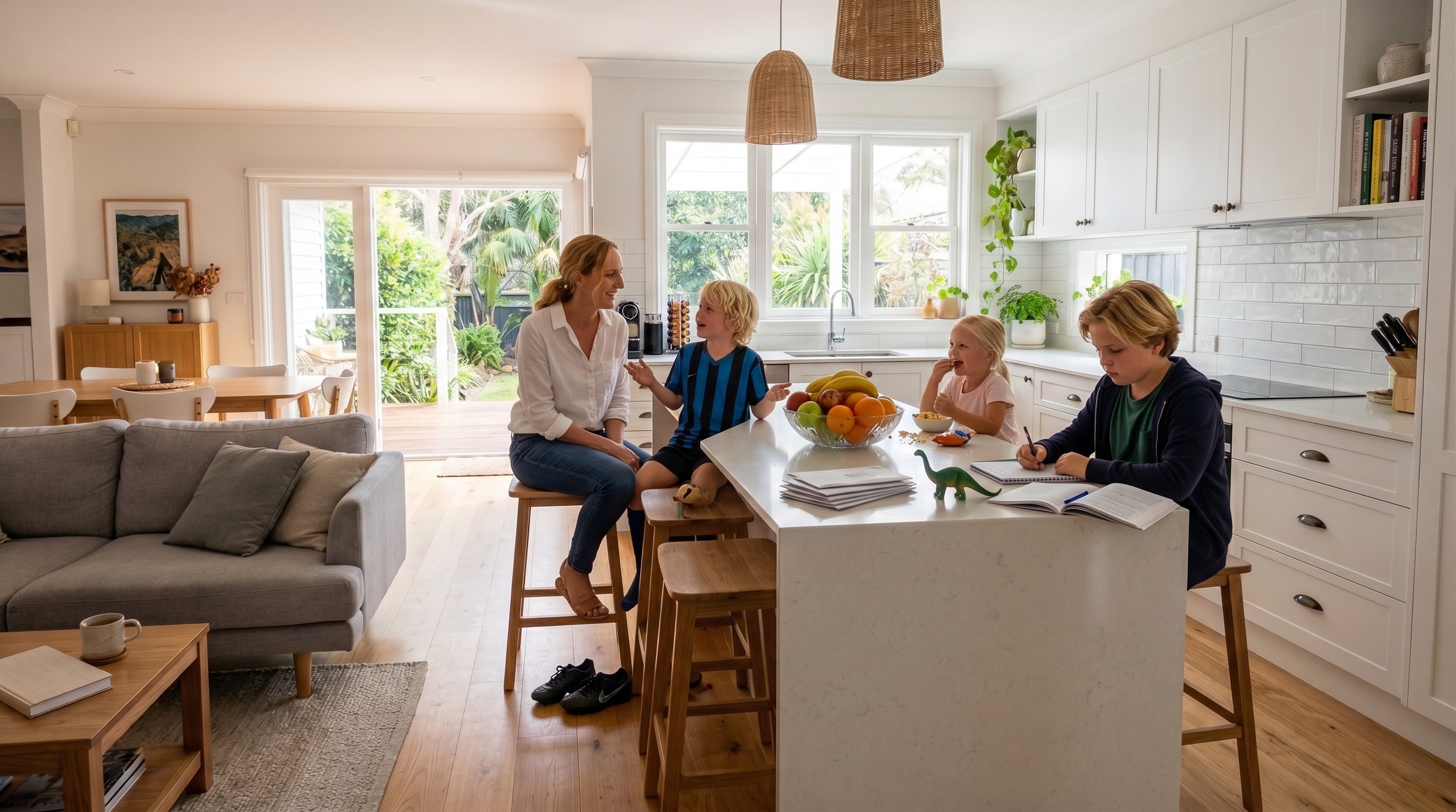
Family in calm after-school environment, each person settled in their own space]
This is the question most articles miss.
Siblings are often the trigger. They want to connect, play, or argue right at the moment when the child with ADHD has zero capacity for any of it. Parents are often already depleted from their own day and have limited regulation to offer. Everyone arrives in the same house at the same time with nothing in place.
The solution isn't to manage the child with ADHD more carefully. It's to design the 3pm to 5pm window for the whole family.
That means:
- Everyone has a decompression plan, not just the child with ADHD
- Siblings have independent activities for that first window
- The parent's role is warm presence, not problem-solving
- Food is ready without negotiation
- The expectations for that time are clear and consistent, every single day
When the system is the plan, you stop relying on everyone having a good day at the same time. In a family navigating ADHD, that's never going to be the strategy that holds.
What if after-school meltdowns are getting worse?
A gradual worsening often signals something specific has shifted.
The school environment may have become more demanding, a change in teacher, a peer situation, academic pressure building. Your child may be experiencing sensory overload during the day that's going unaddressed. There may be something at home adding to the baseline stress. Or the after-school system has gradually worn thin and needs a deliberate reset.
If meltdowns are escalating, becoming physically unsafe, or significantly impacting family life, it's worth getting support from someone who understands ADHD. Not because something is wrong with your child. Because a family under this level of sustained stress deserves a proper plan, not just more tips.
How do I build a whole-family system for after school?
The after-school collapse is one of the clearest examples of a friction point you can plan for instead of brace against. The 3pm crash goes on what I call your family's Friction Map: the two or three moments in the day you already know are coming, mapped so you can build a plan into each one.
That's exactly what we do together in my free online masterclass, The ADHD Family System. We look at what's happening for every person in that after-school window, and we start building the landing ramp that works for your real family and your real life, not a generic routine from someone who doesn't know what your 3pm actually looks like.
You don't need to manage this better. You need a system that does the managing for you.
The masterclass is free and runs live three times so you can pick a session that suits: Tuesday 1 September at 7pm, Friday 4 September at 1pm, or Tuesday 8 September at 7pm (AEST). We start on the 1st.
Register for the free ADHD Family System masterclass →
Join our free ADHD support group
Your tribe is here waiting for you. Join us now.
Want support? Join our Free Community for families navigating ADHD
Recent Posts

Book a FREE 15 min discovery call with Sharon
Sharon is an award winning credentialed ADHD coach and parenting consultant who is specifically trained to work with families navigating ADHD. She is passionate about creating ADHD-friendly systems to make family life easier with ADHD. Find out how she can help you and/or your family.
🎥 Loved this post?
Catch the full conversation on YouTube!
We dive deeper into this topic in the latest podcast episode—real talk, practical tips, and plenty of “oh wow” moments.
Don’t forget to like & subscribe!
