
ADHD and Big Emotions: Why Small Things Trigger Huge Reactions at Home
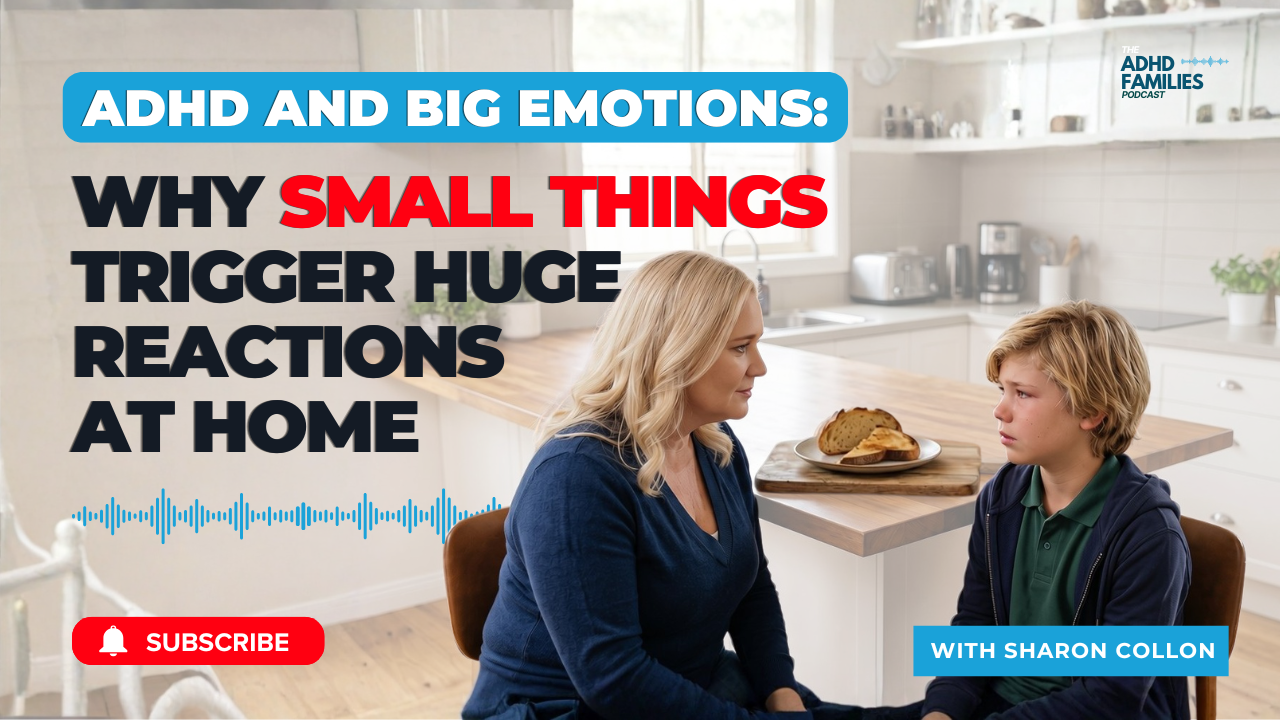
Parent staying calm and close while a child with ADHD moves through a big emotional moment at home.
The toast was cut the wrong way.
That's all it took. One diagonal instead of two rectangles, and the whole afternoon is gone. Tears, a slammed door, a feeling so big it swallows the room, over something that to anyone else looks like nothing.
If you've stood in your kitchen thinking "how is this the hill we're dying on today," you are not alone, and your child is not being dramatic on purpose. In a child with ADHD, big emotions arrive faster and bigger than they do for other children, and the brakes that should slow them down are still being built.
The feeling lasts about ten minutes. The afternoon is gone. That gap between the size of the trigger and the size of the reaction is one of the most confusing, exhausting parts of parenting a child with ADHD. So let's name what's actually happening under it.
I'm Sharon Collon, a PCC Credentialed ADHD Coach and Parenting Consultant, and a mum of three boys with ADHD. I've worked with over 40,000 families across Australia, and big emotions are one of the things parents ask me about most. Here's what's going on, and what genuinely helps.
Why does my child with ADHD overreact to small things?
Because the emotion is not small, even when the trigger is.
Emotional regulation is a skill the brain builds slowly, and in children with ADHD it develops later than it does in their peers. Researchers often describe ADHD as a delay in the brain's self-management system of several years. So a capable, bright ten-year-old can have the emotional braking system of a much younger child. The intelligence is all there. The handbrake is still under construction.
Here's what that means in the moment. When something goes wrong, the feeling floods in fast and at full volume. A neurotypical brain has a half-second buffer, a small pause between the feeling and the reaction. An ADHD brain often doesn't get that pause. The emotion and the explosion arrive together.
So the wrong toast isn't really about toast. It's the moment a nervous system that was already close to the edge tipped over, and the toast happened to be standing there.
What is rejection sensitive dysphoria in children?
Rejection sensitive dysphoria, or RSD, is an intense emotional response to real or perceived rejection, criticism, or failure. It's very common in people with ADHD, and it turns small corrections into something that feels catastrophic.
This is why "can you please put your shoes away" can trigger a reaction wildly out of proportion to the request. Your child didn't hear a small piece of guidance. Their nervous system heard "you got it wrong, you're in trouble, you've disappointed me," and it landed like a physical blow.
RSD is not oversensitivity to be trained out of. It's a wiring difference in how the brain processes rejection. Once you know your child experiences the world this way, a lot of the baffling overreactions start to make sense. You're not supporting a child who can't take feedback. You're supporting a child for whom feedback physically hurts.
You don't have to walk on eggshells. It helps enormously, though, to deliver corrections with warmth, to separate the behaviour from the child, and to repair quickly afterwards.
Why does my child hold it together everywhere except with me?
Because you're the safe place.
Children spend the day managing themselves for teachers, coaches, and friends. That management costs them, and it builds up. With the person they trust most, the pressure finally gets to come off. So the biggest feelings land on you, usually at home, usually at the end of the day.
It doesn't feel like a compliment at 5pm with dinner half-made. It is one, though. The meltdown you're on the receiving end of is a sign your child feels safe enough with you to fall apart. That safety is the foundation everything else gets built on.
Here's a question worth sitting with: in the middle of a big emotion, is your child capable of hearing a reason right then, or does that conversation only ever work once the storm has passed?
How do I help my child with ADHD manage big emotions?
The most powerful tool you have is not a phrase or a consequence. It's your own nervous system.
Young children, and dysregulated older ones, borrow your calm before they can build their own. This is called co-regulation, and it's not a soft idea, it's how the brain actually learns to settle. Your child borrows your nervous system until theirs comes back online. When you stay steady, they have something to steady against. When you match the storm, you both go under.
Here's what that looks like in a real moment.
Reduce the input. Lower your voice. Fewer words. Less noise. A flooded brain cannot process a lecture, so don't deliver one.
Get alongside, not in front. A calm, quiet presence regulates faster than any explanation. Sit nearby. Drop the demand for eye contact. Just be the steady thing in the room.
Name the feeling before you fix the problem. "That felt really unfair" lands. "It's just toast" does not. Naming the emotion helps the brain move through it.
Wait it out. It takes roughly 20 to 30 minutes for a brain to come down from a stress response. You cannot shortcut it, and trying to only extends it.
Do the teaching later. Once your child is calm, then you talk about what happened. Not in the storm. After it.
What doesn't help: raising your voice, delivering consequences mid-meltdown, or explaining why the reaction was too big while it's still happening. None of that reaches a brain that's flooded.
Building a plan for the emotional flashpoints
Big emotions are not random either. Most families have two or three moments in the day where they reliably show up: the after-school landing, the homework hour, the transition to bed. Those emotional flashpoints can be planned for, the same way you'd plan for any predictable part of your day.
That's the work I take families through in my free online masterclass, The ADHD Family System. We find your family's emotional flashpoints and start mapping them onto a Friction Map, so instead of being ambushed by the same reactions you can build calm into the moments you know are coming. Everyone who registers also gets my Emotional Regulation session, which goes deeper on co-regulation and RSD.
The masterclass is free and runs live three times so you can choose what suits: Tuesday 1 September at 7pm, Friday 4 September at 1pm, or Tuesday 8 September at 7pm (AEST). We start on the 1st.
Register for the free ADHD Family System masterclass →
Join our free ADHD support group
Your tribe is here waiting for you. Join us now.
Want support? Join our Free Community for families navigating ADHD
Recent Posts

Book a FREE 15 min discovery call with Sharon
Sharon is an award winning credentialed ADHD coach and parenting consultant who is specifically trained to work with families navigating ADHD. She is passionate about creating ADHD-friendly systems to make family life easier with ADHD. Find out how she can help you and/or your family.
🎥 Loved this post?
Catch the full conversation on YouTube!
We dive deeper into this topic in the latest podcast episode—real talk, practical tips, and plenty of “oh wow” moments.
Don’t forget to like & subscribe!
