
You've Read Everything. Nothing's Sticking. Here's why.
How many tabs about ADHD do you have open right now?
Be honest. On your phone, on your laptop, the ones you meant to come back to. The article about dopamine. The one about demand avoidance. The routine chart someone swore by. The podcast episode you saved at 11pm.
Here is what I want you to know: you are not a parent who lacks information about ADHD. You are one of the best informed parents I know. You could probably explain executive function better than your GP can.
And your Tuesday morning still sucks.
That gap, between everything you know and what actually happens in your house at 7.40am, is not a knowledge problem. Once you can see what it actually is, you can do something about it.
I'm Sharon Collon, a PCC Credentialed ADHD Coach and Parenting Consultant, and a mum of three spectacular boys with ADHD. I've tested most of this the hard way in my own kitchen, crying quietly to myself, wondering why family life had to be this hard. I've supported more than 40,000 families across Australia, and this is the pattern I see more than any other.
Why do I know so much about ADHD and still can't make anything work?
There are two places almost every family gets stuck. I've given them names, because it helps to be able to point at the thing.
The first one is knowledge farming.
This is where you collect. You read the books, you follow the accounts, you listen to the podcasts. You screenshot everything. You know about rejection sensitivity. You know about time blindness. You know your child's brain needs the reward closer to the task.
And you can't implement a single bit of it consistently.
Most of my clients describe this to me as a discipline problem, which always makes me a bit sad, because it absolutely is not. Knowing your child needs an external cue doesn't tell you which cue, where it lives in your house, who maintains it, what happens when it gets moved, or what you do on day three when everyone is thoroughly over it.
Information gives you the what. It almost never gives you the how. And the how is the entire job.
The second trap is system farming, and I'm a system farmer from way back.
This is the next stage. You realise information isn't enough, so you go and buy the thing. The visual schedule. The magnetic chore chart. The Etsy printable with the beautiful fonts. The planner. The token board. The colour-coded whiteboard you spent an entire Sunday afternoon setting up, feeling genuinely hopeful.
And that stops working too. Usually within a fortnight.
Why do ADHD charts and visual schedules stop working after two weeks?
Here's the part that actually gets me.
When the chart stops working, you don't conclude that the chart was a poor fit for your household. You conclude something about yourself. I can't even stick at this. If I was just more consistent. Everyone else is managing this somehow.
That is not what happened.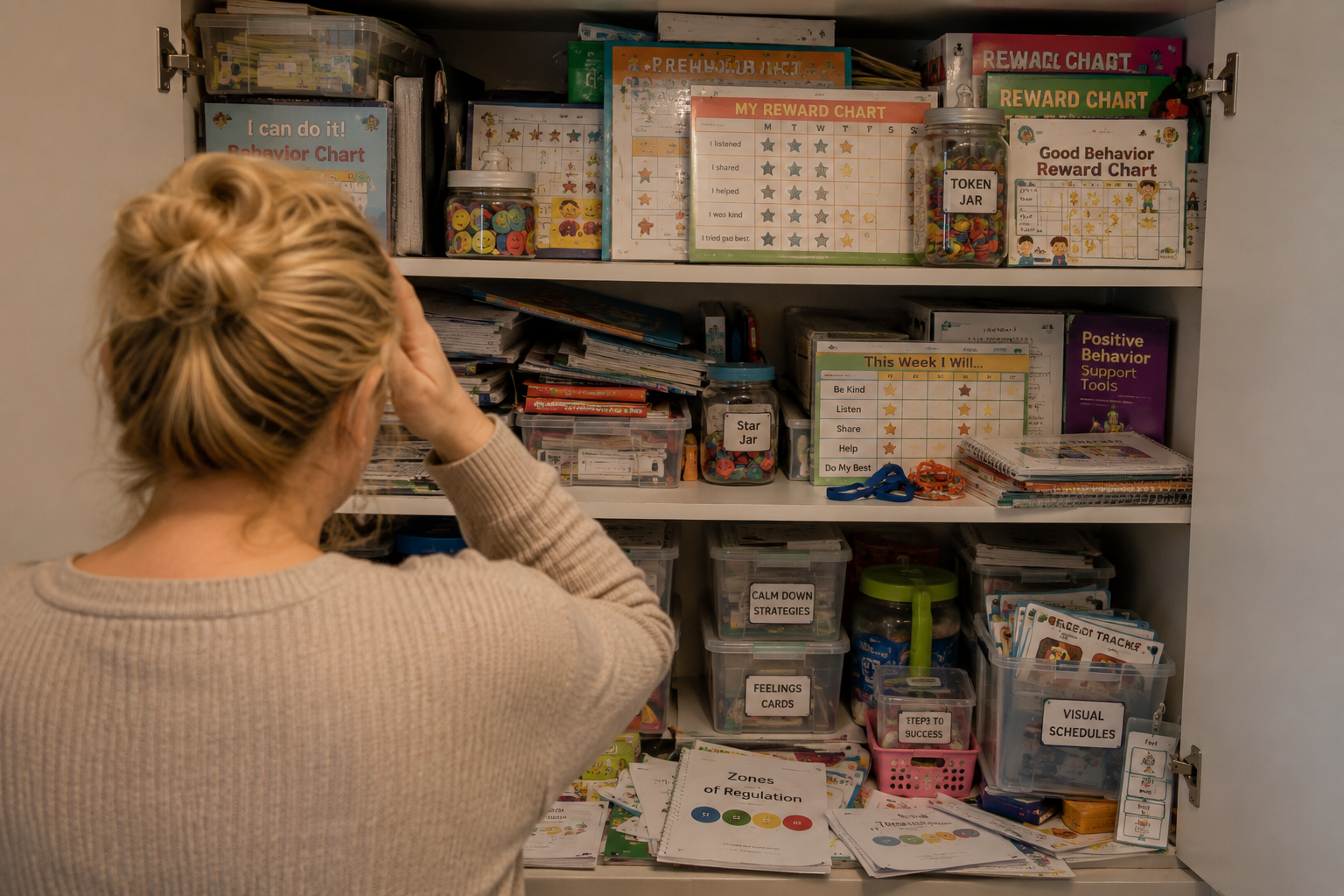 Mum looking at a pile of unused ADHD charts, planners and reward systems that stopped working in her home
What happened is that the chart arrived with no household attached to it.
Let me tell you about two families who came to my place for a barbecue. Both have kids with ADHD, because most of my friends have kids with ADHD. It's called neurokin, it's a real phenomenon. Both of them are lovely, capable, switched-on parents.
At some point in the evening, both of them ended up in my laundry looking at the washing chart my boys use. Both got their phones out and asked if they could take a photo. Of course, take a photo.
But standing there watching them do it, full of genuine hope that their kids might start doing their own washing, I already knew it wasn't going to work in their houses.
That chart on the wall was the last 5% of the work. It was the visible bit. The glamorous bit. Underneath it were months of decisions nobody photographed:
- Who can physically carry a basket up the hallway without it becoming an event
- Where the distraction points are between the bedroom and the machine
- What happens when someone flatly refuses that week
- Who is allowed to remind them, and in what tone, because in my house one brother reminding another brother is not a reminder, it's an instant fight club
- What happens when I'm not home
- What happens when I am home but I've got nothing left
The photo captured none of that.
Why doesn't a system that works for another family work in mine?
Because every household has its own physics.
Somebody moves the shoes. Somebody tidies the launch pad differently and now nothing can be found. One kid does it perfectly and the other one melts down about the unfairness of being asked at all. Your partner has a different threshold for mess than you do. You get sick for four days. There's a birthday party, a late night, a growth spurt, and by Thursday the whole thing has quietly died and you're back to asking six times for everything.
A template can't hold any of that. It was never built to.
So it falls back on the only thing in the house capable of holding it, which is you.
Which means the system isn't running your house. You're running your house, and the system is decoration on the wall reminding you daily of a plan you couldn't sustain.
That's not a gap in you. That's a gap in what's been available to you.
Before you read on, think about the last thing you tried that stopped working. Not why you think you failed. Why did that particular thing become a point of friction in your particular house? Hold onto whatever comes up.
How do I build a routine that actually sticks?
Here is the one shift that changes how you build anything in your home from here.
Build every system for your worst day, not your best one.
I am an outrageous optimist. I plan systems as though I'm going to have maximum capacity, endless time, energy and money. I'm a mum of three kids with extra needs, running a seven-day-a-week business, managing chronic pain. It is genuinely outrageous who I think I am when I sit down to plan things. I have to check myself before I wreck myself, every single time.
Almost everything you've tried was designed on a good day. You sat down on a Sunday afternoon with a coffee and some optimism and you designed something for a version of your family that had slept well, eaten properly and had nowhere to be.
Then Wednesday arrived. Someone woke at 5am screaming "he's got scissors" (a true story from my house). You had a deadline. One child was dysregulated before their feet hit the floor. You couldn't find the garage remote.
The system had no answer for Wednesday, because Wednesday wasn't in the room when you designed it.
What three questions should I ask about a system that isn't working?
Take one thing you've been trying to make stick. Not all of them. One. Then run these three questions over it this week.
Question one: does this work if I'm not in the room?
I'm not expecting you to remove yourself immediately. There's a structure that gets you there. But that is the end goal, because if it doesn't work without you and it's never going to, what you have isn't a system. It's a performance that requires you as the lead actor. And your child hasn't learned anything from it, because the thing doing the work was you.
Question two: does this still work on a bad day?
If it needs everyone calm, regulated and cooperative to function, it isn't going to survive. I have never once had a moment in my house where every single person was calm, regulated and cooperative at the same time. So I don't plan for it.
Question three: what skill is actually missing here?
This is the one that changes everything.
A missing skill looks like defiance. It looks like laziness. It looks like a child who doesn't care, or a child frozen in the hallway. But a skill that hasn't developed yet needs support, not consequences. The brain is on its own timeline.
Getting started is a skill. Stopping something enjoyable is a skill. Holding a three-step instruction in your head while walking down a hallway is a skill, and it's a big one.
When you can name the missing skill, two things change immediately. You stop taking it personally, because it stops being about you or about your relationship. And you stop building systems that punish your child for something they can't do yet, and start building ones that carry the load while that skill grows.
The system isn't there to make a child comply. It's there to do the job your child's brain can't do yet, so they can practise the rest without failing every single day while they learn.
What does it look like when a family gets this right?
I want to tell you about one of our Quest families. Shared with permission, name changed.
I'll tell you where Kate was and where she is now, but I'm not going to hand you the system we built, because it was built for her house and it probably wouldn't survive yours. That's the whole point.
Kate's day was Sunday. She ran it like a full-scale military deployment. Uniforms, lunch supplies, the week ahead, all of it, while everyone else in the family had a nice day. The whole thing sat on one person.
The line I keep thinking about is this one: "By lunchtime on Sunday, I already knew the week had beaten me."
She woke up braced. Shoulders around her ears before her feet hit the floor. And underneath the logistics was a quiet resentment about carrying all of it alone.
She hadn't been careless. She'd done the work. She'd run the Sunday reset, built the chart, colour-coded it, meal prepped, felt genuinely hopeful at 11pm. She had four half-finished courses on her laptop and a podcast history longer than mine. She could have sat in my seat and explained executive function to you.
She was knowledge farming and system farming. She had a library of things that work. She just didn't have one thing in her house that held.
On our first one-on-one call, we didn't talk about how to make Sunday calmer. Calm wasn't available, and chasing it was costing her. We asked about skills instead.
Sunday wasn't a motivation problem in her house. It wasn't an attitude problem. It wasn't a kids-not-pulling-their-weight problem. It was a starting problem. Nobody could see where the job began or where it ended, and we know how much that matters for an ADHD brain. Not the kids, and honestly not Kate either. Because "get ready for the week" isn't a job. It's a category.
So everyone went into paralysis, and from the outside paralysis looks exactly like avoidance. That's why it felt personal. It never was.
We built one thing. One. Built around the start. Built to run without her standing in the room. Then we stress-tested it against her worst Sunday, not her best one, because a system that only survives a good Sunday isn't a system. It's a good mood.
Where she is now, in her words: it's the same three steps every time, and everyone including her knows what happens next. Sunday is done before lunch. The kids run their part, her husband runs his, she runs hers, and if someone has a social thing on, another person can pick up their section.
Monday morning stopped being a fresh emergency, because Monday is now just the outcome of something that already happened on Sunday.
It isn't fairy tale and roses. There are still bad Sundays in Kate's house. Someone gets sick, sport runs late, it's the last week of term. The difference is that it's just a bad Sunday now. It doesn't take Monday, Tuesday and Wednesday down with it. It used to be the first domino. Now it's one hard day inside a week that keeps functioning around it.
She's not living in permanent catch-up mode anymore.
It took four weeks.
Why is it called The Functional Family?
I've never actually said this publicly before.
I don't care about my family being picture perfect. I don't even care about us being the happiest family on the street. Those things come and go in every house.
I care that my kids leave home with the skills they need to function as adults. That's it. That's the whole thing.
And yes, problems will come up for my beautiful boys. But I want them to meet those problems, go "huh", get curious, and know deep down that they have what they need to navigate a spiky world.
The washing chart on my laundry wall was never about the washing. It was about three boys learning that the job exists, that it has steps, that the steps are known to them, and that they can run those steps whether their mother is in the doorway prompting or up the road getting a coffee.
That's what we're building. Not a tidier house, although ours is definitely tidier these days. A set of skills that outlive my supervision.
I'd rather you got there sooner than I did.
How do I stop collecting and start building?
Remember what you were holding onto from earlier? The reason the last thing you tried became a point of friction in your house?
Here's the simplest way I can describe the gap. You have been standing between two things for years: knowledge you can't implement, and systems that won't hold. Your answer came out of that gap.
The ADHD Family Quest is the bridge across it. It's the unglamorous middle bit nobody sells you, and it's the only bit that changes how a house runs.
Four weeks of guided implementation for parents of primary school aged kids with ADHD, though we have plenty of older kids in there too. Here is what that actually does for you.
We name the missing skill together, on a 30-minute one-on-one call with me. Not a group call, not a chatbot. Me. So you start week one on the right problem instead of the loudest one, and you don't spend your first fortnight guessing. This is the bit people tell me afterwards they never would have given up.
The playbooks and templates are already built. Five checkpoints, each one ready to run. So you are not designing something from scratch at 7.40 on a Tuesday with nothing left in the tank.
Every system is built to run when you're not in the room, with the skill-building underneath it so your child can actually get there. So the job belongs to your child and to the house instead of sitting on you.
Three group coaching sessions with me across the three months. Bad days are where everything wobbles, usually around week three, and a system with nowhere to take the wobble is a system that quietly dies. So when it happens, and it will, there's somewhere to bring it. That's also my honest answer to "I'm worried I won't finish it." You won't be doing it alone.
Videos under five minutes, each with one action step. So you actually watch them. If I handed you a 90-minute masterclass you'd save it with every intention and never get to it, and then you'd be carrying that too.
Three months of access, on the app and the computer. So the system lives in your pocket instead of in a folder you can't find.
Now picture December. Last week of school, holidays starting, routines falling away. Now picture walking into that with your systems already built, already tested, already running without you propping them up.
Four weeks from the first of September is the first week of October. That's the whole Quest done, with two more months of coaching to cement it in. Done, with time to spare.
What's in the September Spotlight?
The Quest itself stays open all year. This doesn't.
Enrol before 10pm AEST on Monday 8 September and you also get a seat at the live Family Friction Map Working Group with me on Thursday 10 September. We sit down together and map exactly where your household is losing time and energy, and decide what we're going to do about it. Your house, on the page, with me in the room.
It isn't part of the standard Quest, and it isn't coming back.
The investment is $997 including GST, or four payments of $297. Across three months of access that's about $77 a week, or roughly $11 a day. Add up a couple of specialist appointments where nobody gave you the how, plus the printables and charts you've bought that weren't ADHD-specific enough or came without the skill-building underneath them, and I suspect you're not far off that number already.
One thing I hear every launch: "I think I need one-on-one coaching, a structured program isn't right for us."
I hear you, and I understand why it feels that way. Here's what I've found after working with tens of thousands of families. Almost everyone thinks they need one-to-one. What most of them actually need is structure that doesn't depend on my availability or theirs. One-to-one can become reactive: you bring me whatever happened that week, and we deal with that week. The Quest is layered on purpose. It builds in order, and it keeps building whether or not there's a session in the diary. And you still get me on top of it, in the one-on-one and in the group coaching.
Join the ADHD Family Quest
And if the Quest isn't the right fit for your family, that's completely fine. Go back up to the three questions and run them on one system in your house this week. Does it work without me in the room? Does it work on a bad day? What skill is actually missing here?
That will move you, and it costs you nothing.
You've read everything. I know you have. This week, build one thing instead.
Join our free ADHD support group
Your tribe is here waiting for you. Join us now.
Want support? Join our Free Community for families navigating ADHD
Recent Posts

Book a FREE 15 min discovery call with Sharon
Sharon is an award winning credentialed ADHD coach and parenting consultant who is specifically trained to work with families navigating ADHD. She is passionate about creating ADHD-friendly systems to make family life easier with ADHD. Find out how she can help you and/or your family.
🎥 Loved this post?
Catch the full conversation on YouTube!
We dive deeper into this topic in the latest podcast episode—real talk, practical tips, and plenty of “oh wow” moments.
Don’t forget to like & subscribe!
